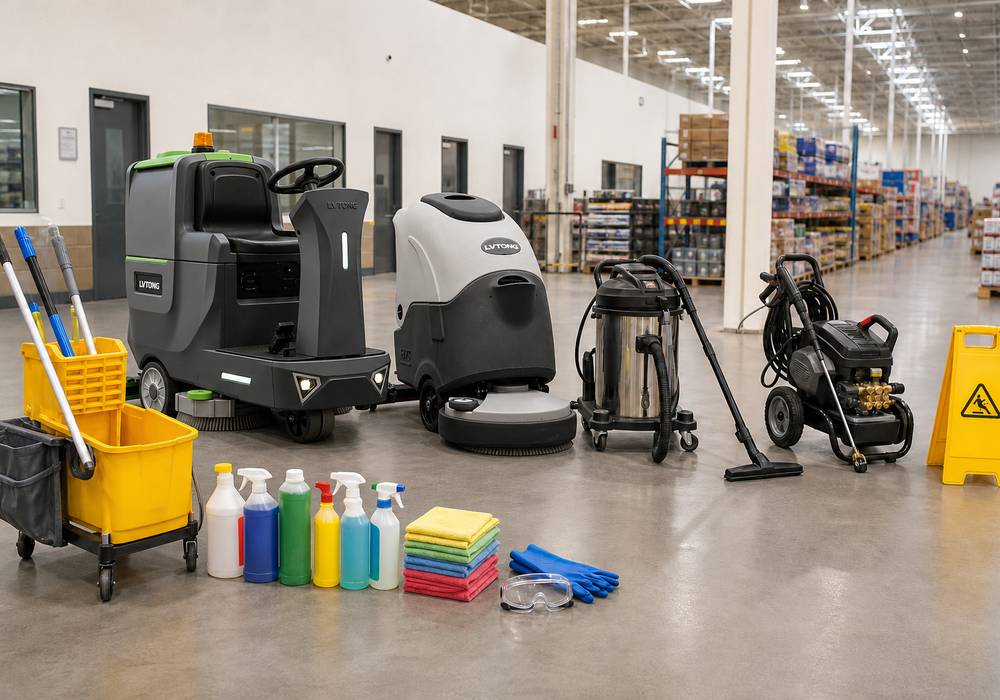
Industrial floor cleaning equipment requires a capital investment of $25,000 to $120,000 per unit, directly impacting maintenance budgets across 100,000-square-foot distribution hubs.
Industrial facilities generate dry particulate and liquid waste that accumulate daily across concrete slabs, requiring specialized mechanical intervention to maintain safety standards.
In 2024, facility audits across 450 North American manufacturing plants showed that manual cleaning methods failed to capture 65 percent of microscopic dust particles under 10 microns.
Selecting appropriate machinery demands analyzing floor porosity, daily traffic volume, and debris composition to prevent premature equipment wear and reduce operational downtime.
-
Sweepers utilize cylindrical main brooms and side brushes to mechanically flick dry cardboard dust, metal shavings, and gravel directly into onboard metal hoppers.
-
Vacuum fan assemblies operating at 300 cubic feet per minute capture airborne particulates to prevent respiratory hazards in enclosed warehouse environments.
Field data collected from 300 logistics centers in 2025 indicated that industrial sweeping units reduced surface particle counts by 82 percent within four hours of operation.
Scrubbers introduce water and chemical detergents onto hard surfaces, agitating embedded grime with disc pads before extracting dirty slurry via rear parabolic squeegees.
Laboratory tests conducted by sanitation institutes in 2023 proved that twin-disk scrubbers removed 90 percent of oil residues from sealed concrete within a single pass.
Facility managers operating food processing plants must deploy wet-scrubbing apparatuses to eliminate organic waste and prevent bacterial growth in wet production zones.
-
Walk-behind scrubbers fit easily into aisles measuring 48 inches wide, maneuvering around fixed industrial shelving and pallet racks with ease.
-
Ride-on scrubber models cover up to 60,000 square feet per hour, reducing operator fatigue during overnight sanitation shifts in massive automotive factories.
Maintenance logs from 500 distribution warehouses in 2024 revealed that pairing sweepers with scrubbers lowered overall floor repair expenses by 45 percent annually.
Heavy aggregate debris mixed with liquid spills requires multi-step cleaning protocols, as sweepers fail on wet surfaces and scrubbers clog when processing large wood blocks.
Engineering benchmarks published in 2025 confirmed that industrial cleaning equipment operated continuously for 1,200 hours before requiring replacement of squeegee blades and vacuum motors.
Facility directors calculating return on investment must factor in replacement costs for batteries, brushes, and dust filters over a standard five-year equipment depreciation cycle.
-
Battery-powered units eliminate cord hazards in high-traffic aisles, providing four to six hours of continuous runtime before requiring a standard recharging station.
-
Propane-powered sweepers offer unlimited runtime for outdoor asphalt yards, provided operators maintain proper ventilation standards to keep carbon monoxide levels low.
Facility safety records from 1,200 industrial plants in 2024 showed that mechanical sweeping and scrubbing reduced slip-and-fall worker compensation claims by 58 percent.
Deploying the correct machine prevents concrete surface etching caused by chemical pooling and extends the functional lifespan of high-cost industrial floor coatings.
Facility audits across 800 manufacturing sites in 2023 demonstrated that regular use of industrial cleaning equipment preserved warehouse floor coatings for up to ten years without resurfacing.