Why 4 mm² and 6 mm² Dominated Rooftop PV Wiring
On most rooftop arrays the DC string cable ends up as 4 mm² or 6 mm², and the reason is arithmetic rather than fashion: the published table puts 4 mm² at 59 g/m and 6 mm² at 78 g/m, so a complete roof run adds only a few kilograms to the mounting rails. KUKA CABLE, a cable manufacturer in Jinshan District, Shanghai, lists 4 mm², 6 mm² and 10 mm² as the commonly used specifications of its solar cable family.
Key takeaways
- 4 mm²: 56 strands of 0.29 mm, 5.5 mm overall diameter, 59 g/m on the published table.
- 6 mm²: 84 strands of 0.29 mm, 6.0 mm overall diameter and 78 g/m.
- 10 mm²: 142 strands of 0.29 mm, 7.5 mm diameter, 130 g/m.
- Published ambient window: −40 °C at the cold end, +90 °C at the hot end, and two short-circuit figures, +120 °C sustained for 20,000 h and +250 °C held for 5 s.
Why the string current settles on two sizes
A string cable has to carry the array's working current every day and survive the fault current that can flow momentarily. Both duties are about the amount of copper inside the sheath, and that is exactly what a cross-section number states. The manufacturer's product pages give the same class 5 flexible conductor in every size, so the difference between 4 mm² and 6 mm² is the number and diameter of the strands, not the type of metal.
Two practical forces push installers towards the same pair of sizes. The first is connector compatibility: switching a run from 4 mm² to 6 mm² does not change the plug at the end, because both fit the standard connector family the site lists as solar connectors, fuse connectors and diode connectors. The second is the drum and the rail: at 78 g/m a 6 mm² cable adds 2.6 times the weight of nothing at all over a 100 m run, but the figure is still modest enough for rails that were specified for module loads. Both 4 mm² and 6 mm² exist as single-core and as twin-core constructions on the manufacturer's solar cable pages.
What each metre weighs on a roof
Weight is the number that decides how hard a roof is to work on, and the cross-section table publishes it directly. Moving from 4 mm² to 6 mm² raises the mass per metre by 19 g, and moving from 6 mm² to 10 mm² raises it by a further 52 g. The overall diameter grows from 5.5 mm to 6.0 mm and then to 7.5 mm over the same steps, which matters when several runs share one clip or one tray.
The bending rule travels with the diameter. The site publishes a minimum bending radius of 4 times the outer diameter, so a 4 mm² cable bends around a radius of about 22 mm and a 6 mm² around 24 mm; those two radii are my own arithmetic on the published diameters of 5.5 mm and 6.0 mm, and they assume the cable is handled at normal ambient temperature. On a rooftop that difference is invisible, which is one reason the two sizes live side by side on the same rail.
Where 10 mm² still earns its place
The larger size is not there to be generous. A 10 mm² conductor carries 142 strands of 0.29 mm and weighs 130 g/m, and it does the job where the distance between the last module and the inverter or combiner box is long enough that the run itself becomes the problem. The same 10 mm² cable is available in the same XLPO insulation system as the smaller sizes, so the joints and the temperature behaviour do not change when a designer steps up.
Stepping up is worth checking on the paperwork rather than on the roof. The published cross-section table lists 4 mm², 6 mm², 10 mm², 16 mm² and 25 mm² with their strand builds, diameters and weights, and the same page is the one a buyer should quote when asking for a quotation. The site does not publish unit prices, minimum order quantities or lead times, so those have to come from the sales contact rather than from the table.
| Cross-section | Conductor construction | Nominal overall diameter | Nominal weight | Radius at 4× (author's calculation) |
|---|---|---|---|---|
| 4 mm² | 56 × 0.29 mm | 5.5 mm | 59 g/m | 22 mm |
| 6 mm² | 84 × 0.29 mm | 6.0 mm | 78 g/m | 24 mm |
| 10 mm² | 142 × 0.29 mm | 7.5 mm | 130 g/m | 30 mm |
| 16 mm² | 238 × 0.29 mm | 8.8 mm | 190 g/m | 35.2 mm |
| 25 mm² | 375 × 0.29 mm | 11.0 mm | 292 g/m | 44.0 mm |
The construction the two sizes share
Both sizes are built the same way on the published 1500 V page: a tinned copper conductor of class 5 flexibility according to IEC 60228, an insulation of XLPO that is cross-linked by an electron beam and described as low smoke halogen free, and a matching XLPO sheath, in black or red. The page states a rated DC voltage of 1.8/1.8 kV, a spark test at 10 kV during production and a finished-cable test voltage of 6.5 kV AC at 50 Hz held for 5 minutes.
The standards named on that page are TUV 2PfG 1169/08.2007, EN 50618:2014 and IEC 62930. Insulation thickness is 0.7 mm and sheath thickness 0.8 mm for the sizes from 1.5 mm² to 10 mm², which covers both rooftop favourites; the larger cross-sections use thicker insulation and sheath walls. Tensile strength before ageing is published as at least 8 N/mm² and elongation before ageing as at least 125%.
What to put on the enquiry
The numbers above are enough to specify a rooftop order without guesswork. A short list keeps the quotation comparable between suppliers:
- Declare the construction you need, for example a 6 mm² twin-core run rated DC 1.8/1.8 kV to EN 50618:2014.
- State the metre length per run and whether you want single-core or twin-core packing.
- Ask for the certificate copy that covers the standard you named; the manufacturer's certificates page lists more than 30 types of certificates including TUV, IEC, CE, SAA and UL, and describes the UL certificate as being updated.
- Confirm the colour split you need, because the published sheath colours are black and red.
Worked example
Take a 40 m rooftop run in 6 mm². The published weight is 78 g/m, so the copper and the two XLPO layers come to 40 × 78 = 3,120 g, or 3.12 kg. That multiplication is mine, and it uses the published 78 g/m figure with no allowance for drums, clips or offcuts.
Run the same length in 4 mm² and the arithmetic gives 40 × 59 = 2,360 g, or 2.36 kg. The step up to 6 mm² therefore costs 3.12 − 2.36 = 0.76 kg of extra load on the rail across the whole run, in exchange for 50% more conductor area. On a ten-run roof that is about 7.6 kg more in total, still a small number next to the module frames, and the bending radius only moves from about 22 mm to 24 mm.
What the published figures show
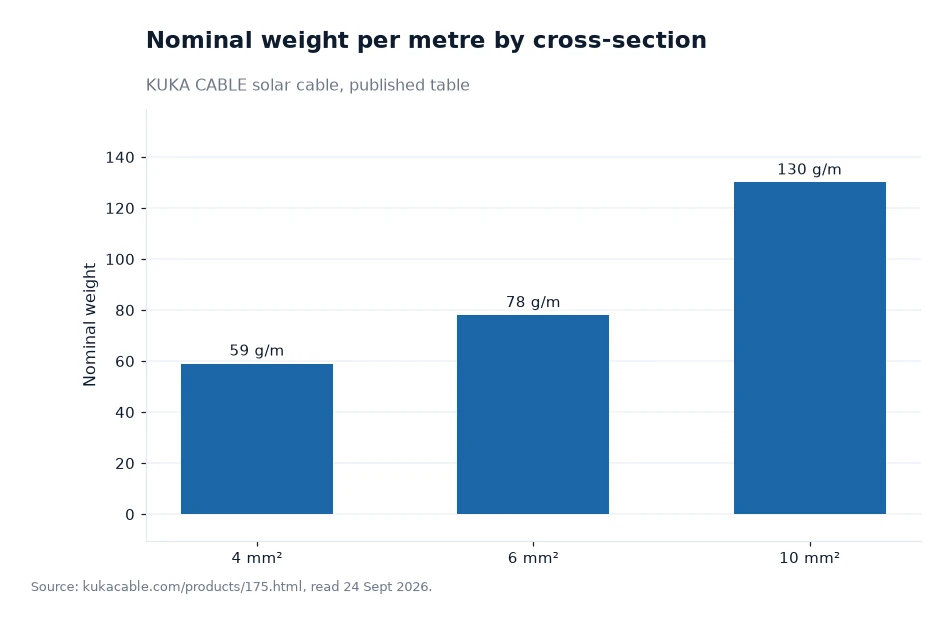
Read the three bars as a cost of copper in grams. The jump from 4 mm² to 10 mm² multiplies the mass per metre by 130 ÷ 59, just over two and a half times, which is why designers keep the large size for the long tails and use 4 mm² or 6 mm² wherever the run is short. The bars also explain why a quotation that only names a cross-section is incomplete: the weight, the diameter and the bending radius all follow from it, and all three are printed on the same page.
Frequently asked questions
Are 4 mm² and 6 mm² the only sizes a rooftop array uses?
No. The manufacturer lists 4 mm², 6 mm² and 10 mm² as the commonly used specifications, and publishes a table that runs from 1.5 mm² up to 240 mm². On a rooftop the two smaller sizes usually cover the string runs, while 10 mm² and above appear on longer tails towards the combiner box or the inverter.
Does the manufacturer publish a price for each cross-section?
The site publishes dimensions, weights, strand builds and test values, but it does not publish unit prices, minimum order quantities or lead times. A buyer should send the cross-section, the standard and the length per run, then ask the sales contact for a quotation that states price, packing and delivery terms in writing.
Choosing between four and six square millimetres
Start from the length of the run and the weight the rail can take, then confirm the two published numbers that matter most: 59 g/m for 4 mm² and 78 g/m for 6 mm². Ask for the certificate copy for the standard you named, and for the cross-section table so that the strand build in the offer matches the page. If the run is long, price the 10 mm² as well before deciding, because the step from 6 mm² to 10 mm² adds 52 g/m rather than 19 g/m.
Weights per metre and strand counts behind this rooftop article come from the manufacturer's own pages at kukacable.com, which I read on 24 Sept 2026[1].